Project Hail Mary Film Review
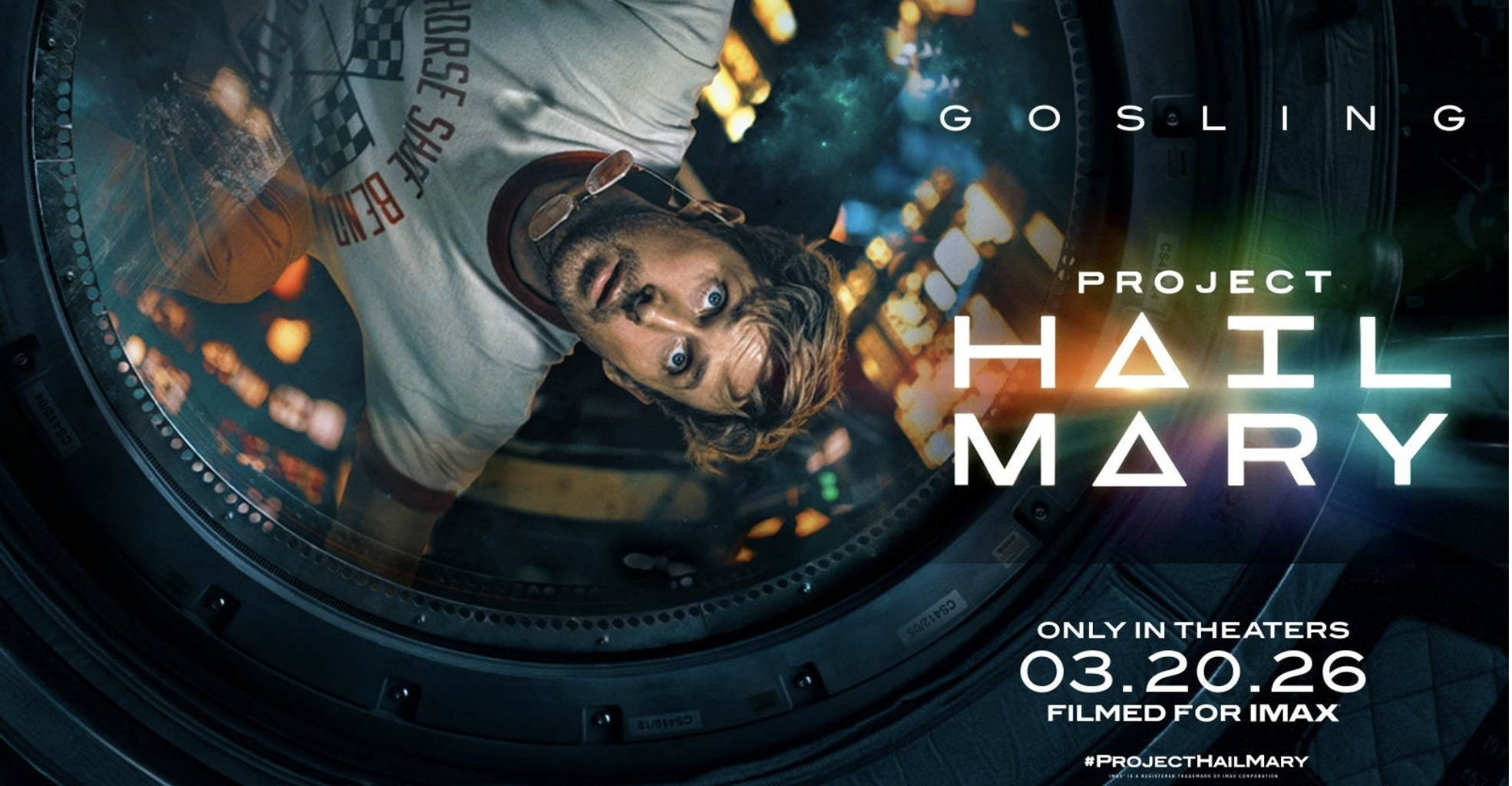
The first face you see in "Project Hail Mary" belongs to a man who does not know his own name. Ryan Gosling blinks awake under fluorescent light, tubes running from his arms, two dead bodies decomposing in cots beside him. He is light-years from Earth. He does not know that yet. Neither does the audience, and director Phil Lord and Christopher Miller are in no rush to explain.
“Project Hail Mary” works because it does something most blockbusters are afraid to do: it slows down. Phil Lord and Christopher Miller's adaptation of Andy Weir's novel, now in its third week in theaters, builds its stakes not through explosions or countdowns but through two characters solving problems together, one equation at a time. There are intricate set-pieces but the attention is on the connection between Rocky and Gosling, which gives the film the personality it deserves.
"Project Hail Mary," directed by Phil Lord and Christopher Miller and adapted from Andy Weir's bestselling 2021 novel by screenwriter Drew Goddard, is the kind of science fiction film that earns its emotional weight honestly. Gosling plays Ryland Grace, a middle-school science teacher turned reluctant astronaut who wakes up on a spacecraft with no memory of who he is or why he's light-years from Earth. As his memories return in fragments, so does the enormity of his mission: solve the mystery of a microorganism called the Astrophage that is slowly killing the sun, or watch humanity go extinct. The film opened March 20 to $80.6 million domestically and currently holds a 95 percent on Rotten Tomatoes, but the numbers only tell part of the story. This is a film that trusts its audience to care about science, and rewards that trust with one of the most affecting friendships put on screen this year. It doesn’t hold the viewer’s hand, or attempt to “dumb down” the science, instead it presents it as-is. This made me trust the movie more and lean in.
Kimario Davis, a senior at DePauw University, saw the film during its opening weekend. “I like when movies don’t give me everything at once,” he said. “Project Hail Mary gives you just enough to care, and slowly shows you more as it goes on.”
The film's first act is essentially a one-man show. Gosling carries roughly forty minutes alone on screen, piecing together his identity through trial and error aboard the Hail Mary spacecraft. It is a performance built on small physical choices–the way he instinctively reaches for a whiteboard to work through a problem, the involuntary flinch when he finds the bodies of his two dead crewmates. Lord and Miller, best known for the tonal gymnastics of “21 Jump Street” and the “Spider-Verse” films, show surprising restraint here. They let silence do work that a lesser blockbuster would fill with exposition.
The real pivot comes with Rocky, an alien engineer from the planet Erid, who is on the same desperate mission from the other side of the galaxy. Rocky is realized through practical puppetry led by James Ortiz and a team of five puppeteers, and the choice to go physical rather than fully digital pays off enormously. Rocky moves with a tactile weight that makes him feel present in the frame alongside Gosling. Their relationship–built first on math, then music, then mutual desperation–becomes the emotional spine of the film.
“The film could be seen as political in nature. It shows how we don’t need a shared language, or a shared culture to connect. Rocky and Ryland are from completely different planets, and they work together and support one another–not because they have to, but because they chose to,” said Davis.
Greig Fraser, the cinematographer behind “Dune” and “The Batman,” gives the film a visual palette that shifts as Grace's memory returns. The present-day spacecraft scenes are rendered in cold blues and sterile whites, while the Earth-bound flashbacks–where Sandra Huller commands the screen as Eva Stratt, the no-nonsense head of the international task force behind the mission–are warmer, denser, more grounded. The contrast works. You feel the distance between the two timelines physically.
The film is not without its rough edges. The second act sags slightly during an extended flashback sequence that covers Grace's recruitment and training, and some of Huller's scenes feel compressed in a way that suggests material was cut. At two hours and thirty-six minutes, it occasionally feels the tension between wanting to be an intimate character study and needing to deliver blockbuster spectacle. But these are minor complaints against a film that gets its biggest swings right.
Alberto Zamora, a senior at DePauw University, saw the movie on opening day. “There’s a beauty about not knowing the unknown and this film symbolizes this through risk and unexpected friendship,” he said. “[I] recommend it to fans of ‘Interstellar’ or ‘The Martian’. [It’s] definitely one of my favorite movies.”
What sets "Project Hail Mary" apart from the current blockbuster landscape is its fundamental argument: that curiosity and cooperation are heroic acts. In a season of sequels and franchise extensions, Lord and Miller have made an original adaptation that treats problem-solving as spectacle and friendship as the highest stakes there are. Gosling, for his part, delivers what may be his most complete performance since "Half Nelson" two decades ago–looser, funnier, and more vulnerable than he's been allowed to be in years.
Go see this in a theater. The sound design alone–after watching it, I had the soundtrack on repeat for days–demands it. Whether you've read Weir's novel or are walking in without ever having even seen the trailer, "Project Hail Mary" is the rare blockbuster that leaves you smarter and more moved than when you sat down. It is the best film of 2026 so far, and it is not particularly close.
"Project Hail Mary" is now playing at theaters world-wide. Tickets and showtimes are available at www.projecthailmary.com. The film is rated PG-13 and runs 2 hours, 36 minutes. For more on the novel, visit www.andyweirauthor.com or your local library.
Aahad Vakani
Writer. Researcher. Developer.
Aahad Vakani works between languages, code, and identity. He builds tools for multilingual speech, writes autofiction about diaspora and family, and reads professional wrestling as a serious art form. He recently graduated from DePauw University with a double major in Computer Science and English Writing, where he received the Roy and Anna Kennedy Prize in Creative Writing. He is now pursuing a PhD in Information Science at Indiana University Bloomington, where his research focuses on multilingualism, code-switching, and the speakers language technology tends to leave behind.